Voimareitti turns a few simple inputs into a personalized strength-training, nutrition and supplement guide you can use, change, print, or ignore. It is a free, automatic tool - not a coach and not medical advice.
Getting started
The first things to do here: build a workout, make a meal plan, save your work and set the basics.
1
Tell us about youAge, sex, height, weight, your training and nutrition goals, experience, training style, days and minutes, and what equipment you have.
2
We estimate your energy and macrosA cited equation estimates your resting and daily burn, then a calorie and protein target for your goal, plus fibre and water.
3
We build the programA deterministic engine picks a weekly structure and exercises that fit your equipment, experience and time, with sets, reps, rest and progression.
4
Use it, print it, adjust itRead it on screen or save a clean PDF. Change any input and the plan changes with it. Come back any time - your inputs stay on your device.
Create a workout program
Open Workout, fill in your profile (age, sex, weight, height, goal, experience, the equipment you have, days per week and minutes per session), pick a weekly emphasis, then press Generate. Your plan appears with sets, reps and rest for each day.
Generate a weekly meal plan
Open Nutrition, set meals per day and any dietary choices, then press Generate. The same profile drives both training and food, so your targets stay consistent. The generated week is temporary and kept only while you stay on the page - reloading starts a fresh week. To keep a week, press Save; only a saved plan is stored on your device.
Save and reopen a plan
Press Save on a workout or meal plan to keep it on your device. Find your saved items under the Saved tab on the Exercises and Recipes pages. Opening a saved meal plan also loads its shopping list.
Change the language
Use the language switcher at the top right to switch between Finnish, English, Hungarian and Swedish. Your choice is remembered on this device.
Your data stays on your device
There is no account and no sign-up. Everything you enter is stored only in your browser, so the same inputs always produce the same plan. Clearing your browser data resets it.
How your training program is built, how to adjust it, and how it adapts to your equipment and situation.
How your program is built
A transparent, rule-based engine builds the plan - there is no random guessing. Sets and reps come from your goal, experience and weekly emphasis; the split (full body, upper/lower or push/pull/legs) follows your days per week and time per session.
Swap an exercise or ingredient
Use the swap icon next to an exercise or ingredient to cycle to a similar option. Exercises swap for the same movement pattern using equipment you have; ingredients swap within the same food family, so an onion stays an onion.
Train with what you have
Tick the equipment you own and the app only picks moves you can actually do. A wall and the floor are always available, so a useful program works even with no equipment at all.
Training your back with no equipment
Pulling your bodyweight needs something to pull on. With no band, bar or sturdy table the plan cannot add real back exercises, so it fills those slots with other moves and shows a tip: add a resistance band or use a sturdy table to train your back properly.
Show easier options
Turn on Show easier options if you are starting out or returning after a break. Swaps then lean toward gentler variations of each movement.
Warm-up and cool-down
Choose a warm-up style (stretching, active drills, both, or mobility only) in your profile. Each session opens with a warm-up and ends with a short mobility cool-down.
Pregnancy and postpartum
If you mark pregnancy or recent birth, the program is built more conservatively (for example it avoids lying flat on the back or front) - it is a personalization, never a block. Always check with your own midwife or doctor, and stop if you feel pain, bleeding, dizziness or contractions.
Meal plans, targets and nutrients
How the meal planner builds your week, the numbers behind your targets, and what each nutrient does.
Read your daily targets
Your targets show calories, protein, carbs, fat and water for the day. Calories are shown as a single target with a small band that the planner stays within, not a hard number. Water is an estimate that rises with training, pregnancy, breastfeeding and age - treat it as a rough guide.
You can set your own targets under Advanced if you prefer. The page also shows BMI, resting (BMR) and daily (TDEE) energy, and an optional waist-to-height screen. These are calculated estimates from your inputs, not measurements or a diagnosis - treat them as a starting point and adjust over time.
Smart cooking vs Precise portions
Smart cooking is the default. It cooks a few dishes in bigger amounts and reuses them as leftovers, so you cook less and waste less. Precise portions instead gives one dish per meal slot for maximum variety. Switch between them with the toggle before you generate.
How leftovers work
In Smart cooking the same cooked dish is reused for up to 3 days in a row, within common fridge guidance, and then a new dish takes over. A "Leftover" badge marks a reused dish. Breakfasts and light items stay fresh and are not carried over.
How often you cook
The Minimal, Balanced and "I enjoy cooking" presets set how many different dishes fill your week. Fewer distinct dishes means less variety and the simplest shopping; more distinct dishes means the most variety.
Regenerate for fresh recipes
The Regenerate button keeps your same targets and settings but picks different recipes, so you can reroll a week you do not fancy without changing anything else.
Set your own targets (advanced)
Under "Advanced: set your own targets" you can type your own daily calories, protein, carbs, fat and water. Leave any field blank to keep it automatic. If the numbers are physically impossible together - for example 500 g protein inside 1000 kcal, when protein alone is about 2000 kcal - the planner explains the conflict and waits for you to adjust them before it builds a plan.
Omnivore by default, plant proteins optional
Plans are omnivore by default, so tofu, tempeh and seitan main dishes are left out unless you tick "Include plant proteins" (or choose a vegetarian or vegan diet). Beans, lentils and other everyday plant foods are always included.
Calories per gram
Protein and carbs give about 4 kcal per gram, fat about 9, alcohol about 7 and fibre about 2. This is why fat is so energy-dense and why protein keeps meals filling for fewer calories.
Food groups and diet guides
Browse the food-group cards below to see example foods and matching recipes for protein, carbs, vegetables, fruit, fats and fibre. The diet guides explain common eating patterns in plain terms.
How the nutrient colors work (weekly)
In the meal planner, each day nutrition-facts box shows today's value as the big number, with a small "wk NN%" underneath for the whole week against its target. The color follows the WEEK, not the day: green when the week is in the recommended range, yellow when it is a little off, and red ("too low" / "too high") only when the weekly total is genuinely below the recommended amount or above the safe upper limit. So one heavy or light day is fine as long as the week balances out. Tap a nutrient box to see your weekly total and range. Nutrients with no established upper limit (like potassium or B12 from food) are never marked "too high". These are general references for healthy adults, not medical advice.
The reference amounts are set by your sex, age and pregnancy, and for each nutrient we use the higher of the US (NIH) and Nordic (NNR 2023) recommendation. If the plan still falls short of vitamin D, vitamin B12, iron, zinc or vitamin C, a small supplement line is added automatically. Calcium, magnesium, folate and potassium are covered from food only - if one of those runs low across the week it is flagged in yellow, not turned into a pill.
We never suggest a calcium supplement. Calcium from food is well supported, but calcium in pill form has been linked in some research to a possible increase in cardiovascular risk (the evidence is debated), so a low-calcium day is topped up with a calcium-rich food such as a glass of milk, not a pill.
Which nutrients can get a supplement
Only vitamin D, vitamin B12, iron, zinc and vitamin C are ever added as a small supplement line, and only if the week falls short. Calcium, magnesium, folate and potassium are covered from food only; a weekly shortfall is flagged, never pilled. Supplements never carry calories.
The day calorie notes
A day can show "well under your calorie target" or "over your target" when its total drifts more than about 10% from the target. These notes are most useful after you swap or add foods, as a nudge to rebalance the day.
Fibre and hydration
Fibre comes from whole grains, beans, lentils, vegetables and fruit and helps meals feel filling. Water needs rise with training, warm weather, pregnancy and breastfeeding - use the water target as a rough guide.
Nutrition basics
How many calories each gram provides (kcal per gram):
4Protein
4Carbs
9Fat
7Alcohol
~2Fibre
Diet
Energy balance comes first. Fat loss or gain is set by calories in vs out. Everything else is fine-tuning.
Protein is the priority. Spread your daily protein target across 3-4 meals to support muscle.
No good or bad foods. Hit your targets with foods you enjoy; sustainability beats perfection (flexible dieting).
Eat for fullness. Lean on high-volume, high-fibre, minimally processed foods to control hunger.
Calibrate over a week. Treat the calorie target as a starting estimate; weigh in weekly and adjust if the trend stalls.
Food groups
Diet guides
FibreBuild up gradually toward your daily fibre target with vegetables, fruit, whole grains and legumes; it improves fullness and digestion.
HydrationAim for clear or pale-yellow urine; more on training days and in the heat. Roughly 30-35 ml per kg of body weight is a sensible baseline.
Filling, low-calorie foodsLeafy salads, broth-based soups, berries, cucumber, tomatoes, popcorn (air-popped), zero-calorie drinks, and plenty of vegetables fill you up for very few calories.
Go deeper on nutrition
Energy balanceCalories in versus calories out decides whether you lose or gain - everything else is fine-tuning.Learn more
Body weight follows one simple rule over time: eat fewer calories than you burn and you lose fat; eat more and you gain. A calorie is the unit of energy in food. No food, macro split, or meal time overrides this balance, so it is the first thing to get roughly right.
You do not need a perfect number. A reasonable starting estimate is your body weight in kilograms times roughly 30-33 kcal per day for a fairly active person, or use the apps estimate as a starting point. Treat it as a hypothesis to test, not a fact.
Then let the scale and the mirror tell you the truth over two to three weeks. If the weekly average is moving the way you want, the estimate is close enough. If it is flat when you want change, adjust food by a small amount (about 150-250 kcal) and watch again. Slow and steady beats guessing daily.
ProteinAim for about 1.6-2.2 g per kg of body weight a day, spread over the day; it protects and builds muscle.Learn more
Protein is the building material for muscle and the nutrient that matters most when you train. A practical daily target is about 1.6-2.2 g per kilogram of body weight. When you are in a calorie deficit and want to keep muscle, the upper end and even up to about 2.4 g/kg can help. Below roughly 1.6 g/kg you leave easy progress on the table.
Spread it across three to four meals rather than loading it all at once. There is no hard limit on how much protein the body can use from a single meal; spreading it simply makes the daily total easier to reach and keeps you full. Roughly 25-40 g of protein per meal is a comfortable, practical range for most people.
Good sources are easy to find: chicken, fish, eggs, lean meat, dairy such as quark and skyr, plus plant options like tofu, beans, lentils and soy products. A protein powder is just a convenient food if whole food falls short on a given day, not a requirement.
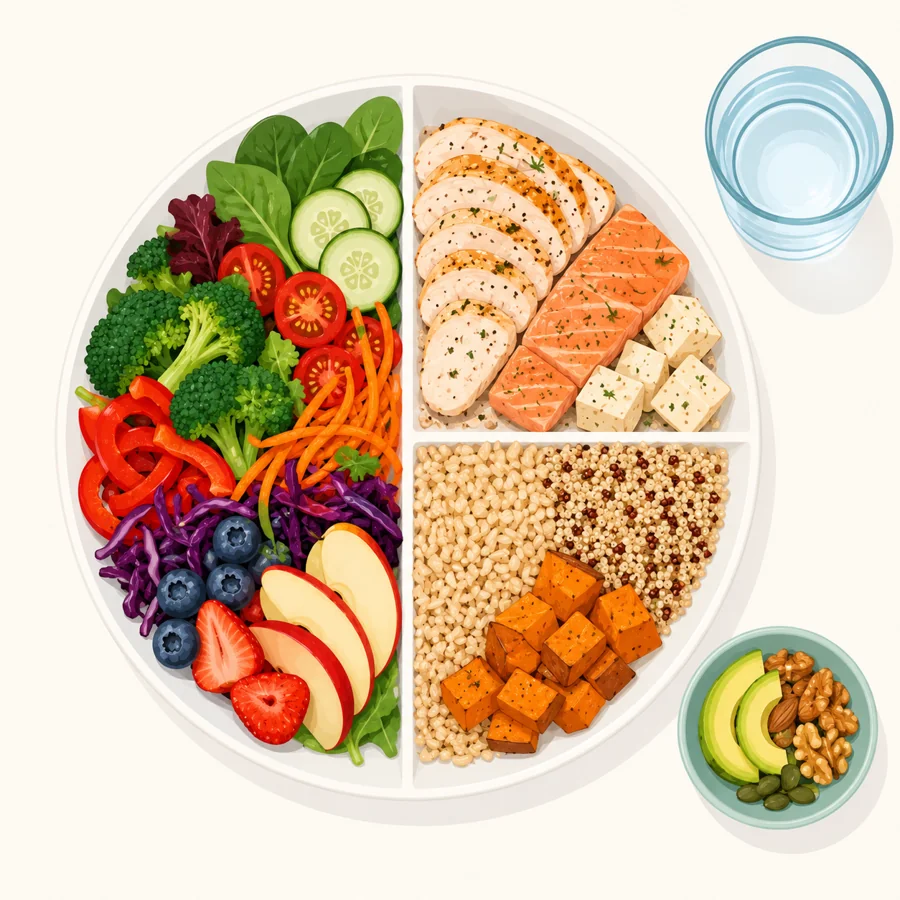
Building a mealUse a simple plate: a protein, some produce, a quality carb and a little fat - timing is flexible.Learn more
You do not need recipes to eat well. A reliable plate has four parts: a palm-sized portion of protein, a generous fist or two of vegetables or fruit, a fist of a quality carbohydrate such as potatoes, rice, oats or whole-grain bread, and a thumb of fat such as olive oil, nuts or avocado. Build most meals this way and the macros mostly take care of themselves.
Meal timing is far more flexible than most people think. Three meals, four meals, or two larger meals all work; eating carbs in the evening does not make you gain fat. What matters is the total over the day and a pattern you can keep up. Pick the schedule that fits your life and hunger, not a rule you read somewhere.
Around training, a meal with protein and carbs in the hours before or after gives you energy and building blocks, but the exact minute is not critical. If your day is busy, just make sure the protein and the produce show up somewhere; consistency over weeks beats perfect timing on any single day.
Carbs and fatNeither needs fearing: keep quality carbs around training and at least about 0.6-1 g/kg of fat.Learn more
Once protein is set, carbohydrates and fat fill in the rest of your calories, and you can lean toward whichever you prefer. Carbohydrates are the bodys easiest fuel for hard training. Putting more of them in the meals around your workout gives you energy when you need it most, while a steady base through the day keeps you feeling good.
Favour quality carbs most of the time: oats, potatoes, rice, whole-grain bread, fruit and legumes. They come with fibre and keep you full longer than sugary, low-fibre options. This is a preference for fullness and nutrients, not a ban; sweeter foods fit too as long as the day adds up.
Fat is needed for hormones and for absorbing some vitamins, so do not cut it too low. Keep at least about 0.6-1 g per kilogram of body weight per day as a floor. Above that, how much fat versus carbs you eat is mostly personal taste. Choose mostly unsaturated sources such as olive oil, nuts, seeds and oily fish.
HydrationRoughly 30-35 ml per kg a day, more in heat and on training days; pale-yellow urine is the simple cue.Learn more
A simple baseline is about 30-35 ml of fluid per kilogram of body weight per day, which for many people lands around 2-2.5 litres. That total includes water, coffee, tea, milk and the water in food, not just plain water. You need more when it is hot, when you sweat a lot, or on heavier training days.
You do not need to count millilitres. The easiest check is your urine: clear to pale yellow means you are well hydrated, while dark yellow means drink more. Thirst is a fine guide for most people, so keep water within reach and sip through the day rather than gulping a lot at once.
FibreBuild toward about 14 g per 1000 kcal from vegetables, fruit, whole grains and legumes - and add it gradually.Learn more
Fibre is the part of plant foods your body does not fully digest. It slows digestion, helps you feel full on fewer calories, and supports a healthy gut and regular bowels. A handy target is about 14 g of fibre for every 1000 kcal you eat, which for most people is roughly 25-35 g a day.
You reach it with everyday foods: vegetables and fruit, whole-grain bread and oats, brown rice, and especially legumes such as beans, lentils and chickpeas. Leaving the skins on potatoes and choosing whole-grain over white versions adds fibre with no effort.
Increase fibre gradually over a week or two and drink enough water alongside it. Jumping from very little to a lot overnight often causes bloating and discomfort, while a slow build-up lets your gut adjust comfortably.
Losing fatA moderate deficit (about 0.5-1 percent of body weight a week), high protein, filling foods and daily steps.Learn more
Fat loss comes from a sustained calorie deficit, but moderate beats extreme. A sensible rate is about 0.5-1 percent of your body weight per week. Faster than that tends to cost muscle and energy and is hard to keep up. The slower end is often the smarter choice because it is easier to live with and protects your training.
Make the deficit easy to tolerate. Keep protein high so you hold onto muscle and stay full, and lean on high-volume, low-calorie foods such as vegetables, salads, broth-based soups, berries and air-popped popcorn that fill the plate for few calories. These two habits do most of the work of managing hunger.
Daily movement helps more than extra cardio sessions. A step target you can hit most days keeps your energy output steady without leaving you ravenous the way long, hard cardio sometimes does. Resistance training stays the priority because it signals your body to keep the muscle you have.
A useful self-check is the feeler week. Once in a while, eat at your estimated maintenance for a week and watch your weekly average. If it holds steady, you have found your true maintenance and can set the deficit from there with confidence. It also gives your appetite and mind a planned break from dieting.
Gaining muscleA small surplus (around 10 percent), protein first, and progressive training as the real driver.Learn more
Muscle grows when training gives the body a reason to build it and food supplies the materials. The food part is a small calorie surplus, roughly 10 percent above maintenance. That is enough to support growth while keeping fat gain low. A huge surplus does not build muscle faster; it mostly adds fat you later have to lose.
The real driver is the training, not the eating. Progressive overload, meaning you gradually add reps, sets or load over weeks, is what tells your body to adapt and grow. Eating in a surplus without that progression just makes you heavier. Keep protein at the priority level, about 1.6-2.0 g per kilogram, so the building blocks are always there.
Expect a slow, honest pace. For most people a gain of roughly 0.25-0.5 kg per month of mostly lean weight is realistic, faster early on and slower with experience. Track your weekly average and your lifts; if both are creeping up over a month, the surplus is about right.
Tracking and adjustingRead the weekly average, not the daily number, and only change calories after two to three flat weeks.Learn more
Daily weight jumps around for reasons that have nothing to do with fat: salt, water, carbs, sleep and the bathroom all move the number. So judge progress by the weekly average instead. Weigh yourself most mornings under the same conditions and look at how this weeks average compares to last weeks. That trend line is the signal; a single day is noise.
Give a plan time before changing it. Two to three weeks of a flat average when you wanted movement is the cue to adjust, not a single stalled day. When you do adjust, change food by a small step (about 150-250 kcal) rather than a big swing, then watch for another two to three weeks. Small, patient changes keep you in control.
You do not have to weigh every gram of food forever. Many people track closely for a few weeks to learn what their portions look like, then loosen to spot-checks. The plate method, a consistent routine and the weekly weigh-in trend are enough to keep most people on course.
Worth understanding nextA few neutral topics worth reading credibly about as you go deeper - no rules, just understanding.Learn more
Once the basics above feel familiar, a little deeper reading helps the pieces click together. Two ideas are worth understanding well because everything else sits on top of them: energy balance over time, and protein distribution across the day. When those two make intuitive sense, most nutrition advice becomes easy to judge.
Sleep and recovery are also worth a read. Short or poor sleep tends to raise appetite and make training feel harder, so they quietly affect both fat loss and muscle gain. Understanding why recovery matters often does more for results than any new food rule.
Most useful of all is learning to tell evidence from marketing. Be a little skeptical of products that promise fast results, secret tricks, or anything that sounds too good to be true. Look for guidance from public health authorities, registered dietitians and researchers rather than supplement sellers. Knowing how to read a claim is the skill that protects you for life.
A closing note: this page is general education, not medical or personalized dietary advice. If you have a health condition, are pregnant, are under 18, or have a history of disordered eating, talk to a doctor or a registered dietitian before making big changes.
Micronutrients
PotassiumLearn more
Helps regulate blood pressure and fluid balance and supports nerve and muscle function. Found in potatoes, bananas, beans, leafy greens and many vegetables. The target is an adequate intake, similar for adults of both sexes.
CalciumLearn more
Builds and maintains bone and teeth and supports muscle and nerve function. Found in dairy, fortified plant drinks, tofu, leafy greens and small fish with bones. The target rises with age. We top up a low day with food (e.g. milk), never a pill (see the weekly-colors note).
IronLearn more
Carries oxygen in the blood and supports energy and immunity. Found in red meat, poultry, fish, beans, lentils, tofu and fortified grains; vitamin C improves absorption from plants. The target is higher for menstruating women and in pregnancy, lower after menopause and for men.
Reaching the higher target from food alone is hard, so if the week falls short an iron supplement is added by default. You can instead choose "Get iron from food, skip iron supplements" in the Food settings: the planner then works harder to pick iron-rich meals and never adds an iron pill. Iron supplements help many people but can be hard on the stomach for some (heartburn, nausea, constipation), which is why the choice is yours. General information, not medical advice.
MagnesiumLearn more
Supports hundreds of enzyme reactions, muscle and nerve function and bone. Found in nuts, seeds, whole grains, legumes and leafy greens. The target is a little higher for men.
ZincLearn more
Supports immunity, wound healing and taste, and is needed for many enzymes. Found in meat, shellfish, seeds, nuts, legumes and whole grains. The target is a little higher for men.
Vitamin CLearn more
An antioxidant that supports immunity, collagen and iron absorption. Found in citrus, berries, peppers, kiwi and many vegetables. The target is a little higher for men and rises slightly in pregnancy.
Vitamin DLearn more
Helps absorb calcium and supports bone, muscle and immunity. Made in the skin from sunlight and found in oily fish, egg yolk and fortified foods; intake matters in the dark Nordic winter. The target rises for adults over 70. Hard to get from food, so it is often the supplement that is added.
Vitamin B12Learn more
Needed for red blood cells, nerves and DNA. Found almost only in animal foods (meat, fish, eggs, dairy) and fortified products, so a plant-based diet usually needs a supplement.
FolateLearn more
Needed for cell growth and forming blood; especially important before and during pregnancy. Found in leafy greens, legumes, citrus and fortified grains. The target rises in pregnancy.
Recipes, shopping and cooking for a group
Finding and scaling recipes, the shopping list, and cooking for a whole household.
Find a recipe
On the Recipes page, search by name or by an ingredient, and filter by course, goal, diet, FODMAP level or a nutrient focus. You can also sort and show nutrition per serving or per 100 g.
Scale servings
Use the servings stepper on a recipe to change how many portions you make; the ingredient amounts and the nutrition update with it.
Cooking for more than one
Add the people who eat with you under "Who else is eating" - as adults, teenagers or children. The plan and shopping list then scale up to feed everyone. On the weekly menu you can switch between "Per person" (one plate) and "Whole household"; the shopping list and recipe amounts are always for the whole household, with a note saying so.
Friendly amounts
Where it helps, amounts are shown as whole units (for example "2 pieces" or "1.5 tbsp") next to the grams, on recipes, the shopping list and the PDF.
Use the shopping list
Open the shopping list from your meal plan. Items are combined across the week and grouped by aisle, and you can check them off as you shop. Your ticks are kept for that plan.
Print or save a PDF
On a result, press Save as PDF (or Print) to get a clean printable handout. Both the workout and the nutrition plan offer a Compact or Full detail choice. Your optional name shows in the header if you added it in the profile.
Gluten-free and lactose-free
When you choose a gluten-free or lactose-free diet, the app keeps a dish whenever an everyday swap exists and simply labels the ingredient (gluten free) or (lactose-free), instead of hiding the recipe. Dishes with no workable swap are still left out.
Supplements
An honest, neutral overview - never part of your plan.
Supplements
This is neutral education, not advertising. Supplements are optional extras on top of good training, food and sleep - none of them are required. Food first, always.
Creatine monohydrate3-5 g per day, any timeThe best-evidenced supplement for strength and muscle; benefits all ages. Optional, not required. Stay hydrated.
Protein / whey powderAs needed to reach your daily protein targetA convenient way to hit protein; whole food first. It is a food, not a requirement.
Vitamin DPer label if deficient; common in northern wintersCorrects a deficiency; consider testing your level. For correcting deficiency, not a performance booster.
Omega-3 (fish or algae oil)About 1 g EPA+DHA per daySupports general health; the food source is oily fish. Optional alongside a varied diet.
CaffeineA sensible pre-workout dose (e.g. a coffee)Can support training energy and focus. Mind your total daily intake and your sleep.
Commonly discussed, not recommended
These come up a lot, but the evidence is weak or mixed. We list them honestly; we do not recommend them and give no dosing. The basics and food come first.
BCAAs.Of little use if you already eat enough protein.
Fat burners.Marketing around a tiny effect at best; no substitute for a calorie deficit.
Testosterone boosters.Over-the-counter boosters do not meaningfully raise testosterone.
Glutamine.Popular but without a clear benefit for healthy trainees.
Taurine.Researched for various effects; the evidence is still mixed.
Resistant starch / fibre supplements.Whole-food fibre is the simpler, cheaper route.
Safety and special situations
What this tool is and is not, plus how it handles situations like pregnancy and breastfeeding.
Not medical advice
Voimareitti is a general wellness tool for healthy adults. It does not diagnose, treat or give medical or dietary advice. For any medical condition, medication or specific dietary need, talk to a professional.
Breastfeeding
If you are breastfeeding, the planner adds some daily energy and water and never sets a weight-loss deficit. It is a personalization, not medical advice - check with your own midwife or doctor.
Your own decision
This is an automatic tool, not personal advice. How you use the program is your own decision and responsibility. Listen to your body and stop if something hurts.
Check allergens yourself
Nutrition values are approximate and depend on the exact products and portions you use. Always check allergens against the labels of the products in your own kitchen.
Made by Mikael Denut as a fun side project - for people who want to move but would rather not spend hours researching how.
Voimareitti is an automatic tool, not advice and not a coach. It only turns your inputs into a suggestion you are free to use, change, or ignore. Everything you do is your own decision and responsibility, and the tool and its makers are not responsible for anything that follows.